CHAPTER 6: Page 9
Some see divine revelation, others see history, symbolism, philosophy, or even fiction. Yet few study Genesis seriously without recognizing its extraordinary influence. And while debates about authorship, timeline, symbolism, science, and interpretation will continue long after I return to dust, the Bible remains. It will continue to be read, continue to be studied, continue to be debated, and continue to be cherished throughout the world. For me personally, that matters. When I look at the…
CHAPTER 6: Page 7
For countless people throughout history, the Bible has not merely been a religious text. It has been a cast for the broken, a prescription for the sick, a defibrillator for the spiritually lifeless, a prophylactic against hopelessness, a source of light in the darkness, and for many, a living testimony pointing toward humanity’s search for truth, redemption, purpose, and a relationship with—I was gonna say the living God, and that’s true, but sometimes familiar words…
CHAPTER 6: Page 6
The New Testament was written between approximately AD forty five and AD ninety five, beginning shortly after the death and resurrection of Jesus Christ. These writings are traditionally associated with apostles and early followers of Christ, including Matthew, Mark, Luke, John, Paul, Peter, James, Juanito, just kidding, and Jude, many of whom either witnessed these events directly or carefully recorded the testimony of those who did. The Bible also stands out to me as unique…
CHAPTER 6: Page 4
The Old Testament was written primarily in Hebrew with portions composed in Aramaic. The New Testament was written primarily in Koine Greek, the common language spoken throughout much of the Roman world during the first century. Over the centuries, these writings were translated into Latin, Syriac, and Coptic, and eventually hundreds of other languages, carrying the message of Scripture across continents, cultures, and generations. The process of translating the Bible became part of world history…
CHAPTER 4: Page 7
That includes you and that includes me. Maybe you think you’re not good enough, smart enough, successful enough. Maybe you feel like you don’t fit in because of your past, your upbringing, your criminal background, your doubts, or even your beliefs. Maybe you’ve never read the Bible. Maybe you’ve never prayed. Maybe you’re agnostic, atheist, unsure. Maybe you believe in multiple gods or in a God that isn’t the God of the Holy Bible. Let…
CHAPTER 6: Page 3
These discussions stem from variations in literary style, parallel or duplicated narrative accounts, differing patterns of vocabulary and terminology, and passages that appear to reflect events or circumstances beyond Moses’ lifetime. And this is where discussions surrounding scripture often become complex. Questions about the Bible involve both historical study and matters of faith. Historians, archaeologists, linguists, and theologians examine the texts through manuscripts, language, cultural context, archaeology, and historical evidence. Religious believers often approach the…
CHAPTER 6: Page 2
The word canon comes from a term meaning rule, measure, or standard. Over centuries, religious communities debated, examined, and recognized which writings they believed carried divine authority and spiritual authenticity. Some books were universally accepted early on, while others became subjects of discussion and theological examination. Prophets, apostles, historians, poets, and inspired authors first penned these writings while councils, rabbis, biblical scholars, patriarchs, monks, bishops, scribes, theologians, and early church leaders played vital roles in…
CHAPTER 6: Page 1
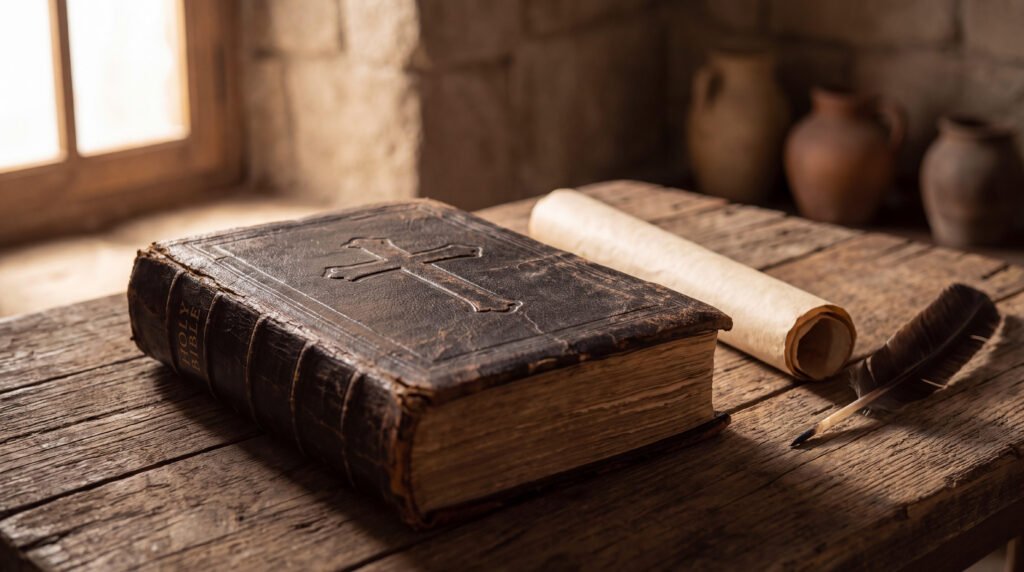
For five chapters, we’ve journeyed through the rise of monotheism, the fall of kingdoms, the worship of false gods, the pull of idolatry, the tension between faith and philosophy, and humanity’s endless search for truth. We’ve confronted polytheism, atheism, agnosticism, and the struggle between trusting the living author of life or placing faith in idols, status, power, and human understanding. But now, every road we’ve traveled leads us here. Chapter six, the Holy Bible. Today,…
CHAPTER 4: Page 3
When the Philistines faced Israel again, they fought fiercely and captured the Ark of the Covenant. For Israel, this was more than a military defeat. It was a spiritual crisis. In 1 Samuel chapter 4, verse 22, Eli’s daughter-in-law names her son Ichabod, saying, The glory has departed from Israel, capturing the heartbreak and despair of the people who believed God’s presence had left. The Philistines saw this as victory and placed the Ark of…
CHAPTER 3: Page 1
Welcome back to Kickoff Ministry. In previous chapters, we’ve explored how humanity has sought to understand the King of Kings and Lord of Lords, the boss of all bosses, God Almighty, the Lord, the Most High, the Father, the Shepherd, the Redeemer, the Creator, the Holy One, and how the Bible tells a radically different story than anything else in human history. In chapter one, we asked the big question: who is God? We explored…