CHAPTER 6: Page 5
Ancient discoveries such as the Dead Sea Scrolls dramatically strengthened scholarly understanding of biblical preservation. First discovered by Bedouin shepherds near Qumran in 1947, including a young shepherd named Muhammad Edib, and later excavated by archaeological teams. Sorry, it’s been a rough morning. I’m just running, I’m firing on all cylinders, and I’m burning both ends of the candle, so I apologize. The Dead Sea Scrolls contain portions of Old Testament writings dating back more…
CHAPTER 6: Page 4
The Old Testament was written primarily in Hebrew with portions composed in Aramaic. The New Testament was written primarily in Koine Greek, the common language spoken throughout much of the Roman world during the first century. Over the centuries, these writings were translated into Latin, Syriac, and Coptic, and eventually hundreds of other languages, carrying the message of Scripture across continents, cultures, and generations. The process of translating the Bible became part of world history…
CHAPTER 6: Page 1
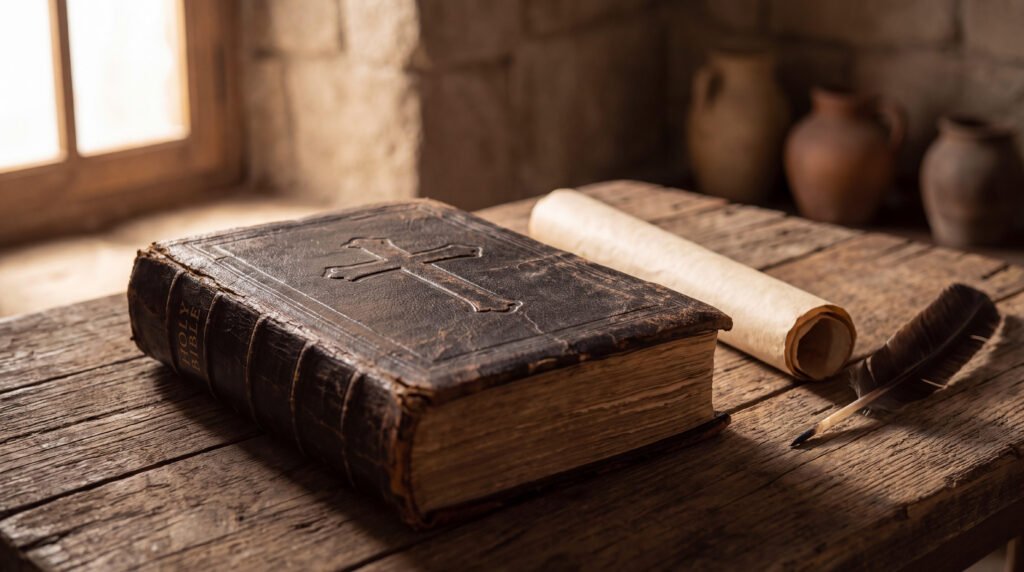
For five chapters, we’ve journeyed through the rise of monotheism, the fall of kingdoms, the worship of false gods, the pull of idolatry, the tension between faith and philosophy, and humanity’s endless search for truth. We’ve confronted polytheism, atheism, agnosticism, and the struggle between trusting the living author of life or placing faith in idols, status, power, and human understanding. But now, every road we’ve traveled leads us here. Chapter six, the Holy Bible. Today,…
CHAPTER 3: Page 3
For the Jewish people, the Exodus is the defining moment when God delivers Israel from slavery with power and faithfulness. At Mount Sinai, he establishes his covenant and gives a clear command in Exodus chapter 20, verse 3. You shall have no other gods before me. From that point on, Israel is called to exclusive loyalty to him. Christians believe that God later carried out the greater rescue plan, sending his son Jesus Christ to…