

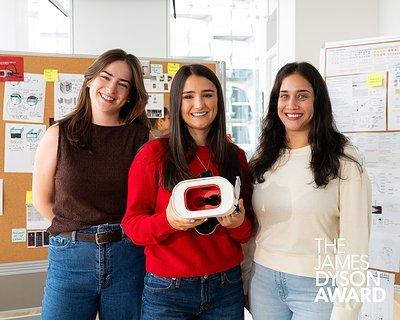
BOSTON – Harvard University students Radhika Saran, Cleo Pontone, and Sophia DeVito have been named the 2026 U.S. National Winners of the James Dyson Award for developing Rumble Rims, a low-cost infrared eye-tracking headset designed to help schools screen young athletes for possible concussions in about 60 seconds. The invention aims to give coaches, athletes, and families more objective information during critical sideline moments, when concussion symptoms can be difficult to identify. The system uses infrared cameras and eye-tracking technology to measure how an athlete’s eyes move, follow, and fixate, then translates that data into guidance that can help determine whether the athlete should be removed from play and referred for professional medical evaluation.
Rumble Rims was created to bridge the gap between expensive clinical concussion systems and more subjective sideline checks. The headset works with a coach-facing display and a recovery dashboard that can be used for repeat testing over time. The team emphasized that the technology is intended as a screening tool, not a diagnostic device, and that return-to-play decisions should remain under the direction of qualified healthcare professionals. Their design was shaped through research and conversations with athletes, coaches, medical professionals, and physical therapists, including feedback that concussion symptoms may become more apparent when movement, heart rate, balance, and eye tracking are challenged rather than when an athlete is simply resting.
The team received $6,500 from the James Dyson Award national prize to support further development of Rumble Rims. Their next steps include building a higher-fidelity prototype, refining the eye-movement testing process, validating the system with athletes and medical advisors, and eventually piloting the technology with schools and youth sports programs. Rumble Rims will also advance to the next stage of the James Dyson Award, with the international Top 20 shortlist scheduled to be announced on October 14 and the global winners on November 4.