

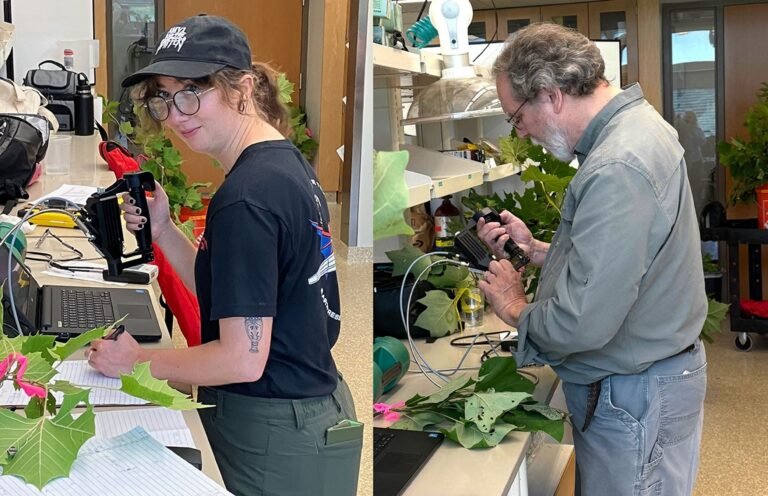
EDGEWATER, MARYLAND — Scientists from NASA Goddard Space Flight Center and the Smithsonian Environmental Research Center are studying how aircraft and satellite technology could be used to measure tree diversity and forest health from above. Working at the Smithsonian’s BiodiversiTREE research site in Maryland, the team examined leaves from different tree species and measured how they reflect light, along with characteristics such as chlorophyll, water content, structure, and photosynthetic capacity. Researchers hope these unique spectral signatures can eventually help identify tree species and assess how forests respond to drought, insects, and other environmental stresses.
The research could make forest monitoring faster and more efficient by reducing the need to identify and count trees individually across large areas. BiodiversiTREE, which includes more than 17,000 trees planted across over 70 experimental plots, gives scientists a controlled setting to compare forests containing single species with those containing mixtures of four or twelve species. By combining ground measurements with hyperspectral sensors mounted on aircraft and satellites, researchers aim to improve understanding of biodiversity, reforestation, and the long-term health and resilience of forests.