
CHAPTER 6: Page 2
The word canon comes from a term meaning rule, measure, or standard. Over centuries, religious communities debated, examined, and recognized which writings they believed carried divine authority and spiritual authenticity. Some books were universally accepted early on, while others became subjects of discussion and theological examination. Prophets, apostles, historians, poets, and inspired authors first penned these writings while councils, rabbis, biblical scholars, patriarchs, monks, bishops, scribes, theologians, and early church leaders played vital roles in…
CHAPTER 6: Page 1

For five chapters, we’ve journeyed through the rise of monotheism, the fall of kingdoms, the worship of false gods, the pull of idolatry, the tension between faith and philosophy, and humanity’s endless search for truth. We’ve confronted polytheism, atheism, agnosticism, and the struggle between trusting the living author of life or placing faith in idols, status, power, and human understanding. But now, every road we’ve traveled leads us here. Chapter six, the Holy Bible. Today,…
CHAPTER 5: Page 9
We are called to walk by faith, not by sight, just as Paul declares in 2 Corinthians chapter 5, verse 7. We are living in a time when conversations about faith, truth, morality, and belief are becoming more visible, more debated, and often more divisive. At times, these discussions may bring understanding and unity, while at other times they may lead to criticism, disagreement, or even hostility toward Christian belief. Whether today, next week, next…
CHAPTER 5: Page 8
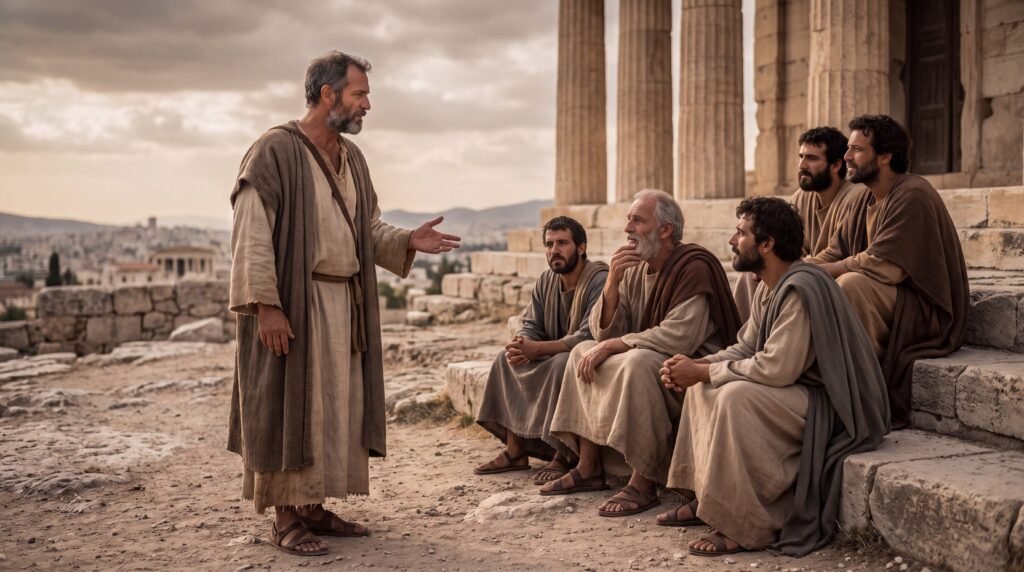
He stood among the philosophers at the Areopagus and addressed them with respect and understanding. He said, Men of Athens, I perceive that in every way you are very religious. For as I passed along and observed the objects of your worship, I found also an altar with this inscription to the unknown God. Therefore, the one whom you worship without knowing, him I proclaim to you. Paul didn’t ridicule their beliefs or attack their…
CHAPTER 5: Page 7
Agnosticism, by contrast, does not firmly deny God’s existence, but claims it’s impossible to know for sure whether God exists. The term was first coined in the 19th century by British scientist Thomas Huxley. Even Charles Darwin, though often labeled an atheist, more accurately described himself as agnostic, recognizing the limits of human knowledge on such matters. While both atheism and agnosticism either reject or question the existence of God, many who hold these views…
CHAPTER 5: Page 6
Rather than viewing God as a personal being separate from creation, pantheists see the divine reflected throughout nature and the cosmos itself. This idea has influenced various philosophical and spiritual traditions, including writings of Baruch Spinoza and certain statements made by Albert Einstein regarding the order and beauty of the universe. In contrast, Christianity teaches that God is both transcendent, existing beyond creation, and immanent, actively involved in it. At Kickoff Ministry, we worship a…
CHAPTER 5: Page 4
Another notable deist was Thomas Paine, whose influential work, The Age of Reason, harshly criticized institutionalized religion, including the Christian church, which he saw as corrupt and oppressive. Paine rejected the authority of the Bible as divine revelation and denied the supernatural elements of Christianity, such as the virgin birth and resurrection of Christ. Yet Paine firmly believed in the existence of one creator and promoted the idea that reason, rather than religious tradition, was…
CHAPTER 5: Page 3
They believe that the universe operates on natural laws that can be discovered through science and reason. Sacred texts, religious rituals, and even prayer are viewed as unnecessary to know God. Instead, they believe morality—knowing the difference between right and wrong and choosing to do what is right—comes from human reason, not divine command. One of the most well-known deists was Thomas Jefferson, the third president of the United States, who famously took several copies…
CHAPTER 5: Page 2
Nations such as North Korea, Iran, and Nicaragua have been criticized by international human rights organizations for limiting religious freedom and preventing people from openly sharing ideas, asking questions, and discussing different beliefs. Conversely, many countries are recognized for their strong commitment to religious freedom and the open exchange of philosophical ideas. Nations such as Canada, the Netherlands, and Australia have legal protections that allow people to practice their faith, change their beliefs, or explore…
CHAPTER 5: Page 1
We’ve been on a journey together, haven’t we? We’ve talked about monotheism, the belief in one true God, the God of Abraham, Isaac, and Jacob, the God who revealed himself to Moses and then led the Israelites out of Mizraim, which is the ancient Hebrew name for Egypt. We’ve also explored polytheism, the belief in many gods. The gods that I mentioned, if my memory serves me correctly, in chapter two, were man-made idols created…