
CHAPTER 4: Page 6
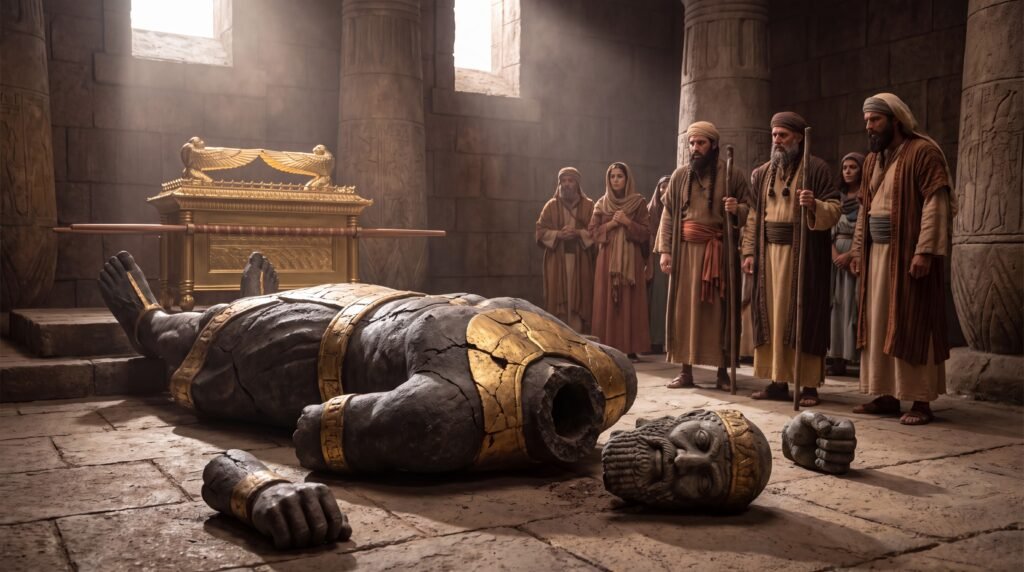
Remember, scripture shows that God didn’t need an army to defend his name. In 1 Samuel chapter 5, Dagon’s statue fell and broke before the ark, and judgment spread through the Philistine cities until they returned it. God made one thing clear: He is the living sovereign Lord, and no idol can stand in his way. But as the ark returned, it wasn’t just Israel’s treasure coming back. It was their wake-up call. And in…
CHAPTER 4: Page 5
As Romans chapter 1, verse 25 says, they exchanged the truth about God for a lie and worshiped and served created things rather than the creator. That’s why we must stay grounded. Keep our hearts fixed on Christ. And remember Jesus’ words in Matthew chapter 6, verse 33, seek first his kingdom and his righteousness, and all these things will be given to you as well. When Jesus says, seek first his kingdom and his…
CHAPTER 4: Page 4
Just like our physical body cannot survive long without nourishment, our spirit cannot thrive or survive without God. Jesus made this crystal clear in the gospel of Matthew chapter 4, verse 4, when he said, Man should not live on bread alone, but on every word that comes from the mouth of God. Today, Christians may not see golden idols on every street corner, but polytheistic thinking and the spirit of idolatry are still alive…
CHAPTER 4: Page 3
When the Philistines faced Israel again, they fought fiercely and captured the Ark of the Covenant. For Israel, this was more than a military defeat. It was a spiritual crisis. In 1 Samuel chapter 4, verse 22, Eli’s daughter-in-law names her son Ichabod, saying, The glory has departed from Israel, capturing the heartbreak and despair of the people who believed God’s presence had left. The Philistines saw this as victory and placed the Ark of…
CHAPTER 4: Page 2
People believed in spiritual realms filled with divine beings, and many still do to this very day. There were gods of the sun, the moon, the harvest, the sea, love, war, and death. These gods were tied to nature, survival, politics, and national identity. Cities were built around them. Kings ruled in their names. Festivals, rituals, and sacrifices shaped everyday life around these spiritual powers. The ancient world was not secular. It was very religious.…
CHAPTER 4: Page 1
Throughout recorded history and across civilizations, humanity has searched for meaning, asking who we are, why we exist, and whether a higher power recognizes each and every one of us living on this vast world that stretches nearly 24,901 miles around the equator. Behind every idol, altar, temple, ritual, sacred text, incense offering, mountain shrine, or painted image lies the same deeper question. Is there one true God or many powers competing for human devotion?…
CHAPTER 3: Page 8
After the return, leaders like Ezra and Nehemiah guided the people. Ezra restored the law of Moses, calling for obedience, while Nehemiah rebuilt Jerusalem’s walls, renewing both security and identity. Exile left a lasting mark. The people learned that faithfulness to Yahweh was essential. Their identity no longer rested on kings or land, but on covenant. Monotheism became their foundation, and during this time, Judaism began to take its lasting form. One verse captures Ezra’s…
CHAPTER 3: Page 7
They declared that Yahweh was not just Israel’s God, but the one true God over all creation. As written in the book of Isaiah, chapter 44, verse 6, I am the first and I am the last. Apart from me, there is no God. This was a turning point. The prophets were laying the foundation for true monotheism, a belief in one God, not limited to a nation or a temple. That idea would later…
CHAPTER 3: Page 6
According to 1 Kings chapter 11, he didn’t just tolerate it. He built shrines for them. Polytheism doesn’t usually start with rejecting God completely. It starts with compromise. Even the wisest king tried to worship Yahweh while accommodating the gods of his wives. He thought he could just add to his faith, but he learned the hard way that partial loyalty is still disloyalty, because that single compromise ultimately tore his entire kingdom apart. Solomon…
CHAPTER 3: Page 5
When we get scared about the economy, our health, or our future, we start hedging our bets. We look to money, politics, or our own success to be our provider, completely forgetting the lesson of Hosea. It is God and God alone who holds our future and provides our daily bread. I mentioned Baal and Asherah in chapter two. Baal and Asherah dominated Canaanite religion, and leaders like Samuel and Deborah warned Israel not to…